Perfume is more than a pleasant fragrance. It is a carefully formulated cosmetic product containing aromatic ingredients, solvents, and other substances that must be evaluated before the product reaches consumers.
For brands planning to enter the United Kingdom or European Union markets, product safety must remain a priority. Therefore, perfume safety assessments are an important part of meeting cosmetic safety requirements. A fragrance may smell appealing and contain familiar ingredients, but that does not automatically mean that its finished formulation is safe for every intended use. The product’s ingredients, their concentrations, exposure levels, and potential allergenic effects must all be considered.
Why Are Perfume Safety Assessments Important?
When we apply perfume, it is generally applied directly to the skin and is often reapplied throughout the day. This makes it important to assess how the finished product may affect consumers under normal and reasonably foreseeable conditions of use.
Fragrance formulations can contain numerous aromatic substances. Some may cause irritation or allergic contact reactions in susceptible individuals, while others may be subject to specific restrictions or concentration limits. The potential risks depend on the substance, its concentration, the way the product is used, and the available scientific evidence.
Perfume safety assessments examine these factors to determine whether a fragrance formulation is safe for its intended cosmetic use. The assessment considers the complete product rather than relying solely on the reputation of an individual ingredient or fragrance supplier.
These assessments are also important because cosmetic products placed on the market in Great Britain and the EU must meet the applicable regulatory requirements. A business cannot assume that compliance in one market automatically satisfies every obligation in the other.
How Does Perfume Safety Assessment Work? A Complete Explanation:
From now on, we understand that a perfume brand’s safety certificate is more important than anything else. Safety evaluation can help brands identify documentation gaps, address formulation concerns, and prepare for the next stages of regulatory compliance.
Step 1: Review the Complete Perfume Formulation
The first step is to establish exactly what the perfume contains. A safety assessor needs reliable information about every ingredient used in the finished product, including its identity and concentration.
During perfume safety assessments, the formulation review helps establish whether ingredients are permitted for the intended use and whether any applicable restrictions have been respected.
Businesses should prepare:
- A complete quantitative formulation showing the exact concentration of each ingredient.
- Recognised ingredient names and relevant identification details.
- Information about the intended cosmetic product and how it will be applied.
- Available technical and toxicological information for the ingredients.
- Relevant supplier documentation for fragrance mixtures and raw materials.
Incomplete ingredient information can delay the evaluation because the assessor may be unable to establish the exposure level or toxicological profile of a particular substance.
Step 2: Obtain the Relevant Fragrance Documentation
During perfume safety assessments, fragrance suppliers often provide technical documents that help manufacturers and safety assessors understand the materials used in a perfume. These documents should be collected before the safety evaluation begins, and these include:
- The important document is the Safety Data Sheet (SDS), sometimes still referred to as a Material Safety Data Sheet (MSDS). It provides information about the properties and hazards of a substance or mixture.
- An allergen declaration is also valuable because it identifies relevant fragrance allergens and their concentrations in the supplied material. This information can help determine whether individual allergens need to be declared on the finished cosmetic product’s ingredient list.
- IFRA Certificate of Conformity may provide additional information about how a fragrance mixture aligns with applicable International Fragrance Association standards for its intended product category.
However, an IFRA certificate is not a substitute for a legally required Cosmetic Product Safety Report (CPSR). It does not independently demonstrate that the finished perfume satisfies all applicable cosmetic safety requirements.
Step 3: Check IFRA Standards and Ingredient Restrictions
The International Fragrance Association (IFRA) publishes standards intended to support the safe use of fragrance ingredients. These standards may restrict or prohibit certain materials in particular product categories or specify maximum permitted concentrations. Businesses should obtain documentation that corresponds to the intended application of the fragrance and the relevant version of the applicable standards.
However, IFRA standards and cosmetic legislation serve different purposes. Compliance with an IFRA standard does not replace the legal obligations imposed by the applicable cosmetic regulations. A product must satisfy the relevant legal requirements and undergo a suitable safety evaluation.
During perfume safety assessments, the available IFRA documentation can help the assessor understand restrictions relevant to the fragrance mixture. The finished formulation must still be evaluated in its own right, including the concentration of the fragrance blend and the other ingredients present.
If a fragrance supplier changes the formulation or issues updated documentation, the brand should consider whether the change affects the existing safety assessment. A previous report should not automatically be treated as valid for a materially different formula.
Step 4: Prepare the Cosmetic Product Safety Report (CPSR)
The Cosmetic Product Safety Report (CPSR) is a central requirement for cosmetic products placed on the UK and EU markets. It records the information supporting the product’s safety evaluation and the assessor’s conclusion.
Under the applicable cosmetic regulations, the CPSR has two main parts.
Part A: Cosmetic Product Safety Information
This part contains the information needed to evaluate the product’s safety. Depending on the product, it includes details concerning the formulation, physical and chemical characteristics, stability, microbiological quality where relevant, impurities, packaging, normal and reasonably foreseeable use, exposure, toxicological profiles, and other applicable safety information.
For a perfume, the information about the fragrance mixture and its individual constituents can be particularly important.
Part B: Cosmetic Product Safety Assessment
It records the safety assessor’s evaluation and conclusion, including the safety conclusion, any necessary warnings or instructions for use, the reasoning supporting the conclusion, and the assessor’s qualifications and approval.
The report must be based on sufficient, relevant information about the actual finished product. A generic report or a document prepared for a different formula may not meet the requirements for the product being marketed. Businesses should therefore provide accurate information and resolve significant documentation gaps before the report is finalised.
Professional perfume safety assessments help ensure that the relevant formulation and safety information is evaluated systematically and that the available evidence supports the conclusion.
Step 5: Review Product Labelling and Warnings
A label review can help identify missing details, incorrect ingredient declarations, and inconsistencies between the packaging and the supporting documentation.
For businesses preparing to launch in the UK or EU, checking labels early can reduce the risk of having to reprint packaging or delay a launch.
Step 6: Organise the Product Information File (PIF)
The Product Information File is the regulatory dossier that contains information about the cosmetic product. It must be maintained in accordance with the applicable requirements and made available to the relevant authorities when required.
The PIF includes the CPSR and other required information, such as a description of the product, evidence supporting claimed effects where applicable, manufacturing information, and relevant statements concerning animal testing compliance.
Perfume safety assessments and PIF documentation work together: the assessment establishes the safety conclusion, while the file keeps the required product information organised and available.
Understand UK and EU Market Requirements:
Although Great Britain and the European Union have similar foundations for cosmetic safety, businesses should understand the separate requirements that apply when selling in both markets.
In Great Britain, cosmetic products must comply with the relevant UK cosmetics framework. Businesses need to meet the applicable requirements for a safety report, a Product Information File, a UK-established Responsible Person where required, labelling, and notification through the Submit Cosmetic Product Notification (SCPN) system before placing products on the market.
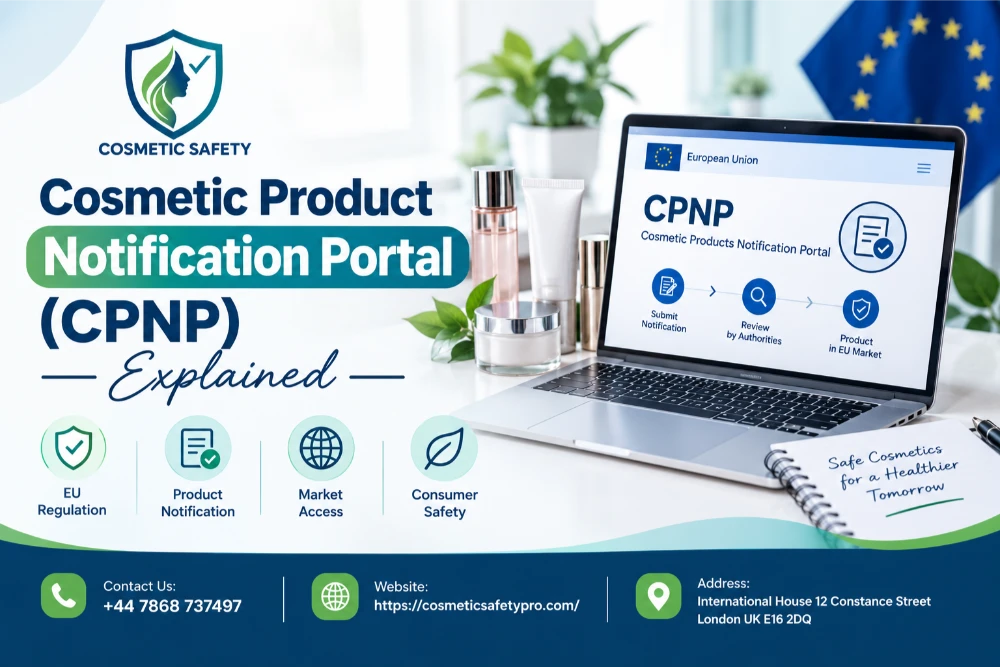
In the EU, Regulation (EC) No 1223/2009 provides the main framework for cosmetic products. Businesses must meet the relevant requirements for a CPSR, PIF, an EU-established Responsible Person, compliant labelling, and notification through the Cosmetic Products Notification Portal (CPNP).
A notification is not the same as a safety assessment, and completing one step does not remove the need to satisfy the others. Planning perfume safety assessments around the intended markets from the beginning can help businesses identify which documentation and regulatory steps are necessary before launch.
How Does Cosmetic Safety Pro Support Perfume Safety Assessment?
Cosmetic Safety Pro supports cosmetic businesses with regulatory documentation and safety compliance for the UK and EU markets. Our relevant services include Cosmetic Product Safety Reports, Product Information File preparation, cosmetic product labelling review, and assistance with applicable product notification requirements.
For perfume brands, the first step is to provide accurate formulation details and the supporting documents available from the fragrance supplier. These may include relevant ingredient information, an allergen declaration, IFRA documentation, and an SDS.
We at Cosmetic Safety Pro also support businesses in organising the documentation required for their Product Information File and in reviewing cosmetic labels for compliance with applicable requirements. Where relevant, the company provides support with UK SCPN and EU CPNP notification requirements.
The aim is to help brands understand their responsibilities and prepare the appropriate documentation without unnecessary confusion. Businesses should provide complete and accurate information so that the assessment and related compliance work can proceed on a sound basis.
Conclusion
Perfume safety assessments help establish whether a finished fragrance is suitable for its intended use by considering its formulation, ingredient concentrations, toxicological information, and consumer exposure. A properly prepared CPSR, supported by accurate documentation, is an essential part of the compliance process.
Brands must also pay attention to product labelling, PIF records, Responsible Person arrangements, and notification requirements. These obligations should be considered separately for Great Britain and the EU, particularly when a business intends to sell across both markets.
Cosmetic Safety Pro helps prepare the required information early and seek appropriate professional support, so perfume businesses can make more informed decisions, reduce avoidable delays, and build a stronger foundation for regulatory compliance. Careful preparation protects consumers while helping brands bring their fragrance products to market responsibly.
Frequently Asked Questions:
Are perfume safety assessments required in the UK?
A compliant Cosmetic Product Safety Report is required before a cosmetic perfume is placed on the UK market. The product must also meet the other applicable cosmetic regulatory requirements.
Does an IFRA certificate replace a CPSR?
No. An IFRA certificate provides information about conformity with relevant fragrance standards, but it does not replace the required safety assessment of the finished cosmetic product.
What documents are needed for a perfume safety assessment?
Typical documents include the complete formulation, ingredient concentrations, relevant SDS documents, fragrance allergen information, IFRA documentation where applicable, and other information needed to evaluate the finished product.
Can a perfume formula change after its safety report is completed?
A change may affect the existing safety conclusion. The business should have the change reviewed to establish whether the report or supporting documentation needs to be revised before the updated product is marketed.